Be yourself; Everyone else is already taken.
— Oscar Wilde.
This is the first post on my new blog. I’m just getting this new blog going, so stay tuned for more. Subscribe below to get notified when I post new updates.
Be yourself; Everyone else is already taken.
— Oscar Wilde.
This is the first post on my new blog. I’m just getting this new blog going, so stay tuned for more. Subscribe below to get notified when I post new updates.
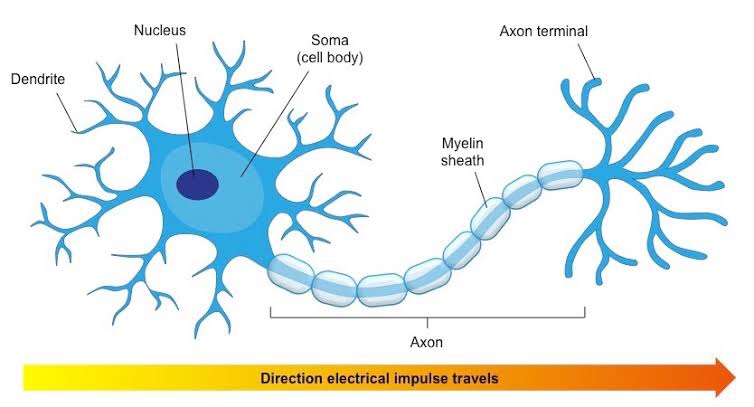
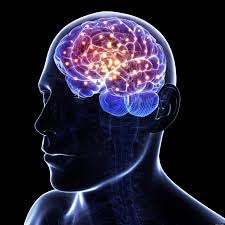
Neuron /nerve cells is the basic fundamental unit of the nervous system. The brain contains many billions of Neuron that work together to produce sensation,thought, learning ,movement,emotion and many other processes.
Neuron comprise a cell body (soma), Dendrites, an axon that ends at a terminal.
Cell body (=Cyton or soma)
The cell body contains the nucleus, which contains the DNA, or genetic material of the cell surrounded by cytoplasm.The cytoplasm has mitochondria, Golgi apparatus, rough endoplasmic reticulum, ribosomes, lysosomes, fat globules, pigment granules, neurofibrils, neurotubules and Nissl’s granules.
The cell body is also the region of the Neuron in which an electrical impulse is generated .
Neurites:
The processes of neurons are called neurites. These are of two types: dendrites or dendrons and an axon or axis cylinder or neuraxon.
Dendrites (Dendrons):
These are usually shorter, tapering and much branched processes. They may be one to several. The dendrites contain neurofibrils, neurotubules and Nissl’s granules. They conduct nerve impulse towards the cell body and are called afferent processes (= receiving processes).This electrical impulse (action potential) propagates from the cell body, along the axon towards its terminal.
b) Axon:
Axon is a single, usually very long process of uniform thickness. The part of cyton from where the axon arises is called axon hillock. Most sensitive part of neuron is axon hillock.
It is an elongated fibre that transmits the impulse by altering the flow of sodium and potassium ions across the neuronal membrane. Many axons are surrounded by a myelin sheath,an insulating material that helps to prevent the signal from degrading.
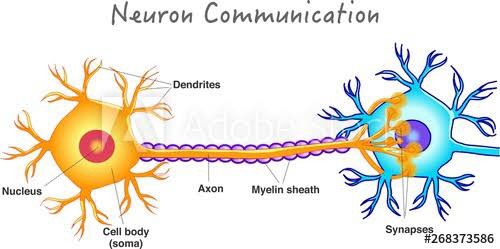
The last step for the action potential is the axon terminals,also known as synaptic buttons. When the signal reaches the axon terminals it can cause the release of neurotransmitters.
When a neurotransmitter is released from axon terminal, it interacts with receptors on the Dendrites of the next Neuron and then the process repeats with the next Neuron.
This is an example post, originally published as part of Blogging University. Enroll in one of our ten programs, and start your blog right.
You’re going to publish a post today. Don’t worry about how your blog looks. Don’t worry if you haven’t given it a name yet, or you’re feeling overwhelmed. Just click the “New Post” button, and tell us why you’re here.
Why do this?
The post can be short or long, a personal intro to your life or a bloggy mission statement, a manifesto for the future or a simple outline of your the types of things you hope to publish.
To help you get started, here are a few questions:
You’re not locked into any of this; one of the wonderful things about blogs is how they constantly evolve as we learn, grow, and interact with one another — but it’s good to know where and why you started, and articulating your goals may just give you a few other post ideas.
Can’t think how to get started? Just write the first thing that pops into your head. Anne Lamott, author of a book on writing we love, says that you need to give yourself permission to write a “crappy first draft”. Anne makes a great point — just start writing, and worry about editing it later.
When you’re ready to publish, give your post three to five tags that describe your blog’s focus — writing, photography, fiction, parenting, food, cars, movies, sports, whatever. These tags will help others who care about your topics find you in the Reader. Make sure one of the tags is “zerotohero,” so other new bloggers can find you, too.

 tenzin